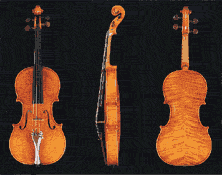
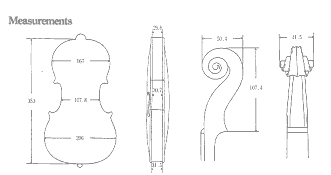
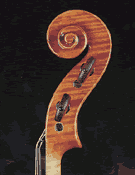
 Giovanni Battista Morassi was born in July, 1934 at Arta in Udine, Italy. Given his family background in which his maternal grandfather operated a lumbermill and his maternal uncle made violins, it seemed that his future in violin making was inevitable. Urged by his teacher at his vocational school and his father’s friend, and with a four-year scholarship from the Udine Chamber of Commerce, Industry and Agriculture, he entered the International School of Violin Making at Cremona in 1955. He graduated from the International School of Violin Making in 1971 and maintained that Status until his voluntary retirement in 1983.
His violins won Italian and international prizes and are used by famous orchestra violinists and soloists. He contributed greatly to the education of many successful Italian and foreign students at Cremona. He judges numerous domestic and foreign music contests. His string instruments are based on either the classical Cremonese school like Stradivari and Guarneri del Gesu in particular, or on his personal model. He also devotes himself to the restoration of old instruments.
His message: The violins that are perfect in their artistic, and cultured aspects are produced when a right balance between wood technology and the makers’ powerful and individualistic varnish is met.
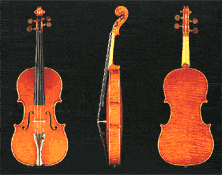
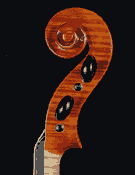 Ivano Coratti was born in 1933 at Ospital Monacale in the northern Italian province of Ferrara. He was already a carpentry apprentice when he enrolled in the clarinet class at the Conservatoire of Bologna where he received diplomas in both clarinet and bassoon playing He later joined one of the Bologna orchestras.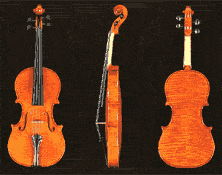
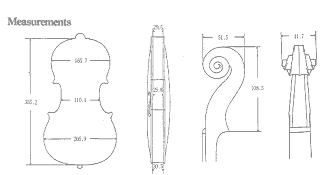
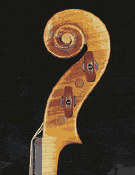 Joachim Schade was born in 1934, in Halle.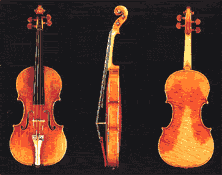
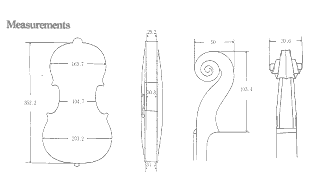
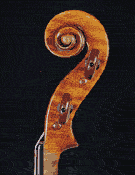 Louis B. Bellini was born in 1935, in Monte Azul Paulista, Brazil. He began his career as a wood sculptor, learning from and working with Mr.Pascoli from 1955 to 1960. However, his reputation as an extremely reliable violinmaker and restorer of old instruments was built during his days with Mr. Sacconi at the Wurlitzer workshop in New York.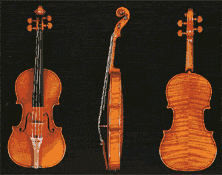
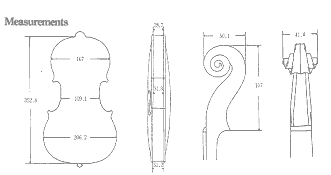
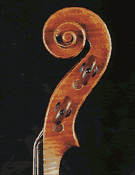 Premysl O. Spidlen was born in 1920 and can be called the doyen of Czech luthiers.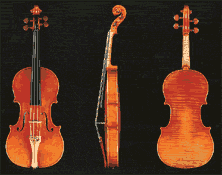
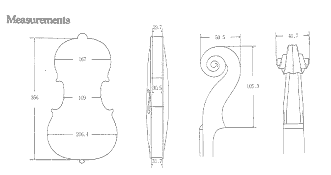
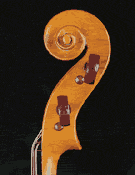 Togliani in 1927. In 1944, He began his career by self-teaching. At the age of 24, he took his latest violin to the SCUOLA INTERNAZIAL DI LIUTERIA DI CREMONA and he was encouraged to enter the scuola by maestro Peter Talar. He obtained his diploma in 1955, and moved to Parma. After winning numerous prizes he taught violin making at both the CONSERVATORIO A. BOITO DI PARMA and the SCUOLA COMMMUNALE DI LIUTERIA DI MILANO from 1975. In 1980 he was invited as the guest of honor to the International Exhibition of Contemporary violin Making in Tokyo and Osaka. He created 185 violins, 56 violas, 37 violincellos, 3 contrabasses, 2 viola d’amore, one lute, and other string instruments.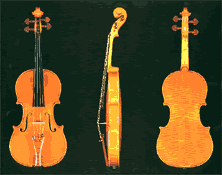
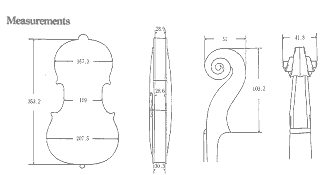
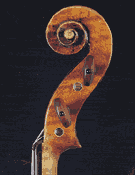 Born in a village, in Akita Japan, in 1945, Tetsuo Matsuda credits a childhood surrounded by music as the inspiration for his violin skills.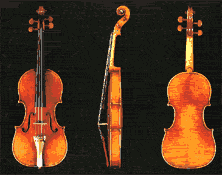
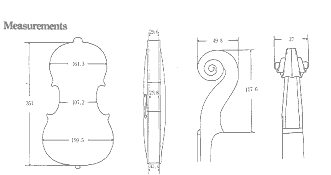
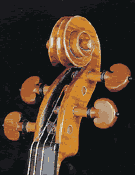 Sergio Peresson was born in 1913, in Udine, Italy. After the Second World War, he moved to Venezuela where he mainly repaired violins for the Venezuelan Symphony. In the early 1960,s he moved his domicile to the United States where he began making violins on his own as well as doing repairs. By the time of his death in 1991, at the age of 78, a number of his instruments were owned by illustrious players, including soloists around the globe.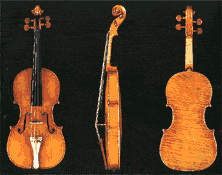
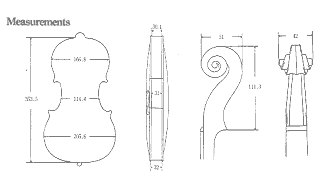
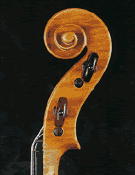 He was born in 1926 into a well known Czech violin making family. His son, Tomas, learned violin making from him, and now his grandson, Jan is also learning the craft too under him.